
Company Name: ZHICHENGJIN Tech. Co Ltd
Email: info@feiverse.shop
Address: Nanshan District, Shenzhen, Guangdong 518000, China
FEIverse - Chinese Calligraphy for Contemporary Spaces


Launched
Couldn't load pickup availability
Made-to-order items may require 2 extra business days.
Man Jiang Hong (Full River Red) is one of the most celebrated works in Chinese classical poetry. Traditionally attributed to the Southern Song general Yue Fei, it speaks of a homeland lost to war, an unfinished mission, and an unwavering determination to reclaim what was lost.
Its words carry a powerful movement from grief and anger to duty and resolve.
Written by hand with brush and ink, this work gives those emotions a visible rhythm through the movement, pressure, and spacing of each stroke.
Man Jiang Hong · Full River Red
Man Jiang Hong is the name of a traditional Chinese ci poetry tune, a poetic form with established patterns of rhythm and line length.
The name is commonly translated as Full River Red. In this work, the title refers to the poetic form rather than a literal image of a red river.
Grief, Duty, and Unbreakable Resolve.
Man Jiang Hong expresses the anguish of seeing one's homeland divided by war, the frustration of unfinished work, and the determination to restore what has been lost.
Beneath its powerful language is a deeply human feeling: the refusal to abandon something that matters, even in the face of overwhelming difficulties.
It is not a poem about finding peace. It is about holding on to purpose.
Man Jiang Hong · Xie Huai (满江红·写怀) is traditionally attributed to Yue Fei (1103–1142), a celebrated military general of China's Southern Song dynasty. Although its authorship has been debated, the poem has long been closely associated with his legacy of loyalty and resistance.
The poem reflects the historical memory of the Song dynasty's lost northern territories and the desire to recover them.
Its opening lines are filled with anger and frustration. As the poem unfolds, that emotion becomes a declaration of duty and determination. It ends with a resolve to reclaim the lost homeland and return in triumph.
Over generations, Man Jiang Hong has remained an enduring expression of patriotic feeling, loyalty, and courage in Chinese culture.
In this handwritten interpretation, brush and ink offer another way to experience its emotional intensity. Changes in pressure, movement, and spacing bring a physical presence to words that have been remembered for centuries.
The intention is not to illustrate the poem, but to let its spirit emerge naturally through the act of writing.
Learn more about Chinese calligraphy, its materials, and the studio practice behind the work in our FEIverse Learn section.
Each FEIverse calligraphy work is written individually by hand, not printed or digitally generated.
Natural variations in brush pressure, ink density, spacing, and movement make each handwritten piece unique. These differences are part of the character of the work, rather than imperfections to be removed.
The writing is allowed to retain its natural energy, without unnecessary embellishment.
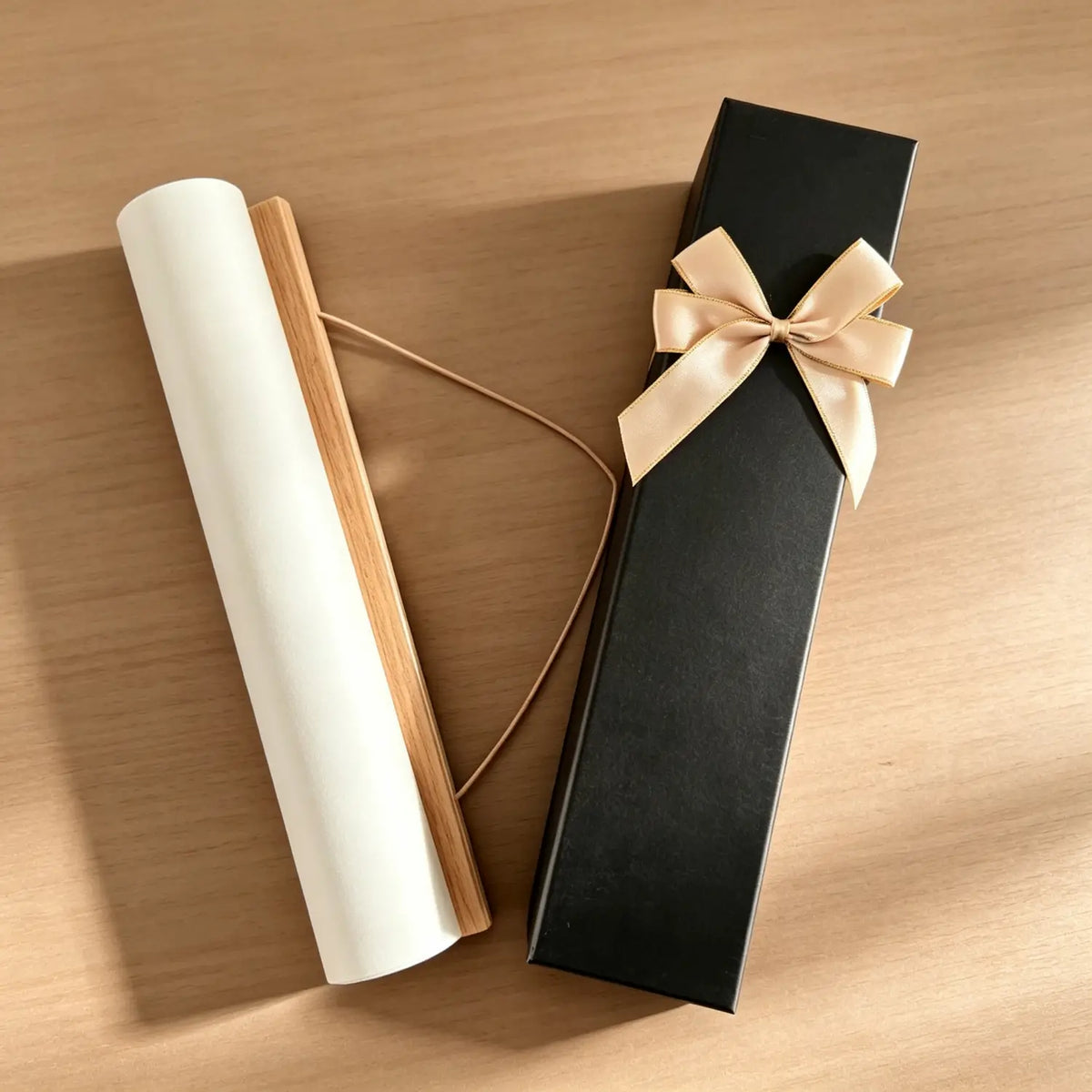
Presented in a restrained vertical hanging-scroll format, the work allows the calligraphy to unfold naturally from line to line.
The mounting is kept deliberately simple, leaving the handwritten text, paper, and overall proportion as the main visual elements.
This minimal approach brings a traditional form of Chinese calligraphy into contemporary spaces without diminishing the character of the original writing.
Although Man Jiang Hong carries powerful emotions and a rich historical background, its visual presentation remains simple and understated.
The contrast of black ink and pale paper allows the writing to stand on its own, bringing depth and cultural meaning into a space without unnecessary decoration.
It can sit naturally in a study, reading room, library, personal workspace, or a quiet corner of the home.
Rather than demanding constant attention, the work offers something to return to over time: a poem with history, strength, and meaning.
Man Jiang Hong (Full River Red) is the name of a traditional Chinese poetic form. This artwork features the celebrated poem Man Jiang Hong · Xie Huai, traditionally attributed to the Southern Song general Yue Fei. It expresses grief over lost territory, loyalty, and the determination to restore what has been lost.
The poem is traditionally attributed to Yue Fei, one of the best-known military figures of China's Southern Song dynasty. However, its authorship has been the subject of scholarly debate. It remains closely associated with Yue Fei and his cultural legacy.
Man Jiang Hong is commonly translated as Full River Red. It is the name of a traditional Chinese ci tune pattern, rather than a literal description of the poem's subject.
The poem conveys grief, anger, loyalty, and an unwavering sense of duty. Its central theme is the determination to reclaim a lost homeland despite adversity.
Yes. Each FEIverse artwork is written individually by hand using traditional brush and ink. It is not a print or digitally generated reproduction.
Yes. Subtle differences in brush movement, pressure, ink, and spacing make each handwritten piece unique.
The work is presented in a minimal vertical hanging-scroll format, with a restrained mounting style that keeps attention on the handwriting and the composition.
The artwork can be displayed in a study, reading room, library, living area, or personal workspace. Choose a location with enough wall space to appreciate the full composition.
Display the work indoors, away from prolonged direct sunlight, excessive humidity, and significant temperature changes. Handle the mounted artwork gently and avoid touching the paper surface.
For more detailed guidance, see our Care & Preservation guide.
Yes, particularly for someone who appreciates Chinese poetry, history, calligraphy, or works that express courage and determination. Its historical meaning makes it especially thoughtful for someone with a personal connection to Chinese culture.


Company Name: ZHICHENGJIN Tech. Co Ltd
Email: info@feiverse.shop
Address: Nanshan District, Shenzhen, Guangdong 518000, China